Every kilim tells a story. To read it, you need to know the alphabet.
A Language Without Paper
In the highland villages of Anatolia, a woman who could not read or write could still compose a message so layered, so precise, that it communicated her marital status, her deepest fears, her hopes for her children, and her spiritual beliefs – all in a single textile.
She did this through motifs.
Kilim motifs are not decoration. They are vocabulary. Each symbol carries a specific, widely understood meaning, refined and transmitted across generations. When a weaver placed a ram’s horn beside a hands-on-hips figure, she wasn’t making an aesthetic choice – she was writing a sentence. Strength protects the mother. The family will endure.
This visual language is one of humanity’s oldest surviving communication systems. Variations of these motifs appear across a vast geography – from the steppes of Central Asia to the mountains of the Caucasus to the plains of Anatolia – because they traveled with the nomadic peoples who wove them. They predate every alphabet currently in use.
And they are alive today – in village kilims, in museum collections, and now, in the digital motif library of Temple of Loom.
Here is the alphabet.
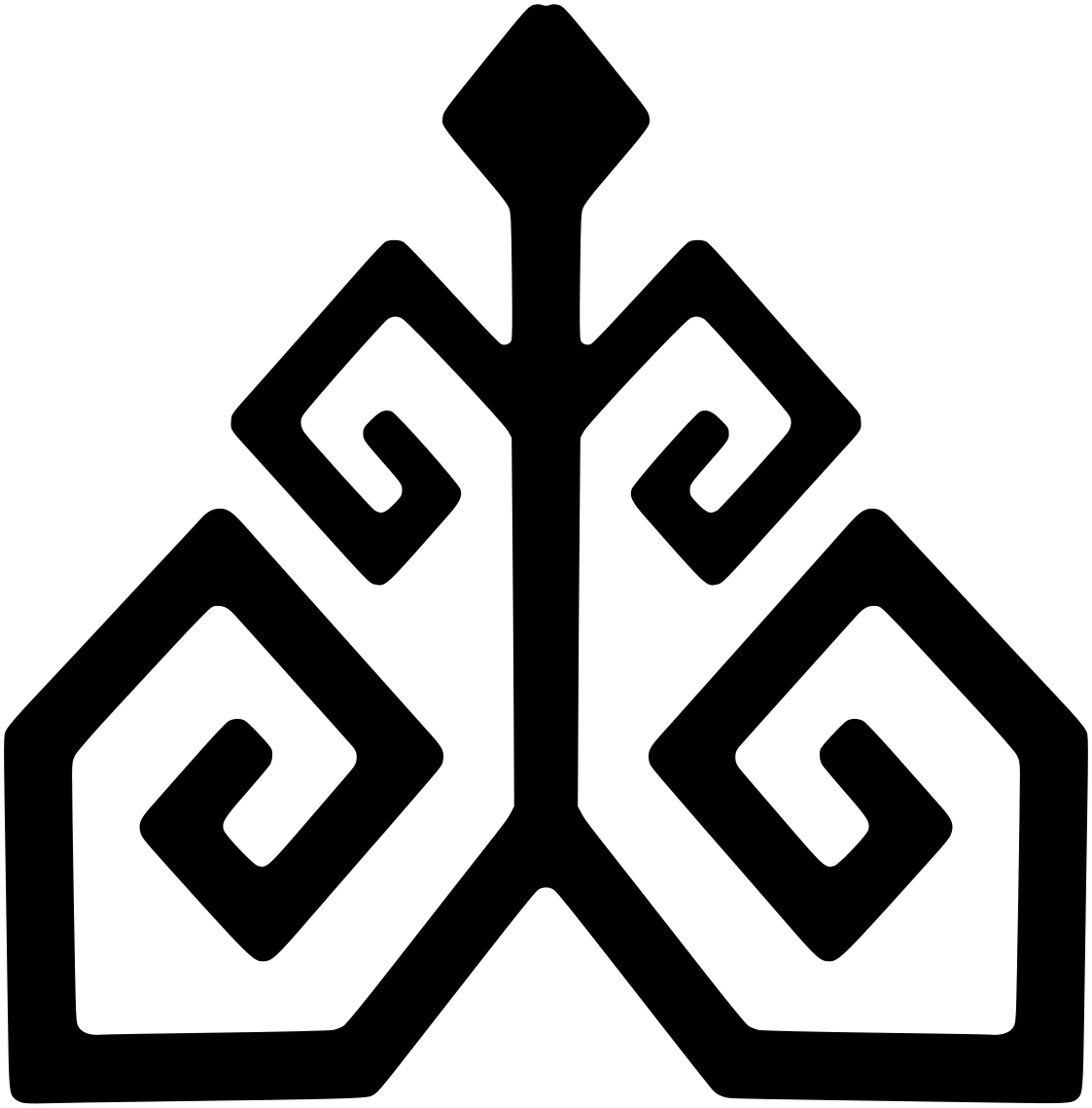
Elibelinde – Hands-on-Hips
The ultimate symbol of Fertility and Motherhood.
The Elibelinde is perhaps the most recognizable and emotionally powerful motif in the entire Anatolian weaving tradition. It depicts a stylized female figure standing with hands pressed firmly to her hips – a posture of confidence, strength, and maternal authority.
This is not a passive figure. She is planted. Grounded. Her wide stance and angular arms suggest a woman who has borne children, who has endured, who stands as the axis around which family life revolves.
The motif’s origins may reach back to the Mother Goddess figurines of Çatalhöyük – the same broad-hipped, powerful female forms that Neolithic Anatolians sculpted in clay nearly nine thousand years ago. In the kilim, she became abstract – reduced to her geometric essence – but lost none of her power.
When woven: Brides wove the Elibelinde into their trousseau kilims as a prayer for children and a declaration of readiness for motherhood. Mothers wove it into family kilims as a mark of their role as the family’s anchor.
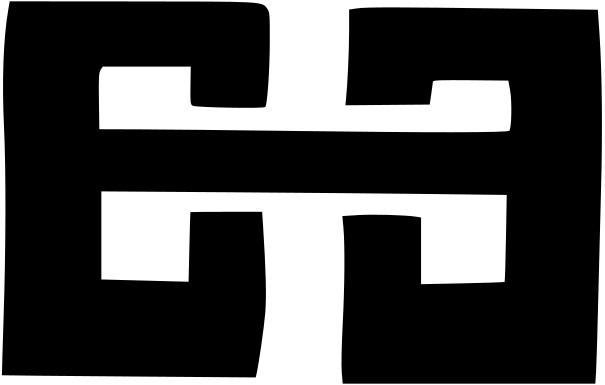
Koçboynuzu – Ram's Horn
Masculinity, Heroism, and Power.
If the Elibelinde represents the feminine principle, the Koçboynuzu represents its masculine counterpart. The motif depicts the curling horns of the ram – an animal that held enormous symbolic importance for Turkic nomadic cultures.
The ram was wealth. In pastoral nomadic life, the size and health of one’s flock determined survival. A powerful ram with large, curling horns was the pride of the herd – a symbol of virility, strength, and prosperity.
When woven: The Koçboynuzu frequently appears in kilims made for or by men – prayer kilims, kilims intended as gifts for male family members, or kilims celebrating a son’s birth.

Bereket – Fertility & Abundance
A prayer for Prosperity: family, crops, and flocks.
The Bereket motif is abundance made visible. It represents the fundamental prayer of agricultural and pastoral peoples: let there be enough. Enough children. Enough grain. Enough lambs in the spring. Enough rain.
This is not greed. In the marginal landscapes where many kilim-weaving communities lived – high plateaus with harsh winters, arid steppes where drought could mean death – abundance was not luxury. It was survival.
When woven: The Bereket appears in kilims associated with the home and hearth. It was a fixture in kitchen-area textiles, grain storage bag decorations, and wedding kilims.

Kurt Ağzı – Wolf's Mouth
Protection from literal predators and spiritual enemies.
The wolf occupied a complex place in Turkic nomadic cosmology. It was feared – the wolf was the primary predator of the flocks that sustained nomadic life. But the wolf was also revered. In Turkic origin mythology, the Ergenekon legend tells of a she-wolf (Asena) who guided the ancestral Turkic people to freedom. The wolf was simultaneously threat and ancestor.
The Kurt Ağzı motif harnesses this duality. By weaving the wolf’s mouth – its most dangerous feature – into a kilim, the weaver captured and contained that danger. The predator’s power was trapped in thread, turned from threat into protection.
When woven: Commonly woven into kilims used near the edges of the home – doorway hangings, entrance rugs – where it served as a guardian against both physical and spiritual intrusion.
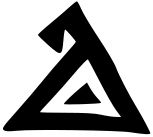
Akrep – The Scorpion
Warding off Evil. The weaver captures its danger and prevents it from entering the home.
In the hot, dry landscapes of southern and eastern Anatolia, the scorpion was a daily reality. Its sting could be fatal, especially to children. The Akrep motif employs the same magical logic as the Wolf’s Mouth – by representing the dangerous creature in thread, the weaver binds its power.
This is apotropaic magic at its most direct: you depict the thing you fear in order to control it. The scorpion in the kilim is a scorpion that can never sting.
When woven: Especially common in regions where scorpions were a genuine threat. They appeared in floor kilims, sleeping area textiles, and children’s cradle covers.

Göz – The Evil Eye
Protection against the "Jealous Eye."
The Evil Eye belief – the idea that envious or admiring gazes can cause harm – is one of the most widespread and ancient superstitions in human culture. In Turkish culture, it is called nazar, and protection against it is woven into the fabric of daily life – literally.
The Göz motif in kilims represents the eye itself, turned back upon the viewer. It is a mirror-shield: the evil eye sees itself and is deflected. Concentric squares or diamonds, often with a central dot, create the unmistakable impression of an eye staring outward.
When woven: Virtually everywhere. The Göz is perhaps the most universally deployed kilim motif. Its placement is always strategic – facing outward, toward the source of potential harm.
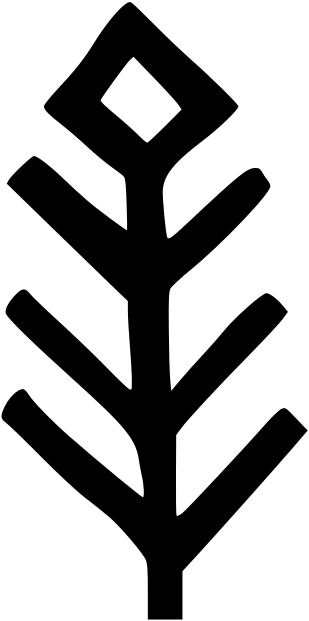
Hayat Ağacı – Tree of Life
Immortality and Continuity. It connects the earth to the sky.
The Tree of Life is not unique to kilim culture – it appears in virtually every human civilization, from Norse Yggdrasil to the Bodhi Tree of Buddhism. But in the Anatolian weaving tradition, it takes on specific and deeply felt significance.
The Hayat Ağacı represents the axis mundi – the cosmic axis connecting the underworld (roots), the earthly realm (trunk), and the heavens (branches). For nomadic peoples living under vast, open skies, the tree was a powerful symbol of permanence. It was the thing that stayed when everything else moved.
When woven: The Tree of Life appeared in kilims associated with spirituality and transitions – prayer kilims, funeral textiles, and kilims marking major life passages.

Bukağı – The Fetter / The Shackle
Family Unity and Love. The bond between a couple or the desire to keep the family together.
The Bukağı is one of the most poignant motifs in the kilim vocabulary. It depicts a shackle or chain link – and its meaning is both beautiful and bittersweet. It represents the bonds that hold a family together, the ties that should never be broken.
The word “bukağı” literally means a hobble or fetter – the device used to restrain an animal’s legs. In kilim symbolism, this restraint is transformed from something negative into something desired. The family that is “bound” together is the family that endures.
When woven: Most commonly woven by women experiencing or fearing separation. It was a textile prayer: let us not be parted. Let the bonds hold.
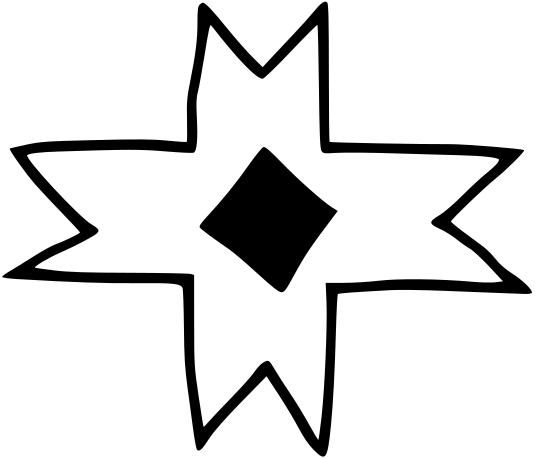
Yıldız – The Star
Happiness and Rebirth.
Look up from the Anatolian plateau on a clear night and you understand immediately why the star is one of the most fundamental motifs in kilim weaving. In a landscape without electric light, the night sky was overwhelmingly present – a vast dome of stars that guided travelers, marked seasons, and inspired awe.
The Yıldız motif captures that celestial brilliance. It represents happiness – the star as a bright point in darkness – and rebirth, because the stars return every night, eternal and unchanging while everything on earth shifts and decays.
When woven: Stars were especially favored in celebratory textiles – wedding kilims, kilims marking the birth of a child, and festival pieces. An abundance of star motifs in a kilim generally signals joy and optimism.

Su Yolu – Running Water
Life and Cleansing. Water is the most precious resource for a nomad.
For peoples living in arid and semi-arid landscapes, water was not a metaphor for life – it was life, literally. The difference between a season with rain and a season without was the difference between survival and catastrophe.
The Su Yolu motif depicts flowing water as a continuous, undulating line – a wave pattern that often runs as a border around the entire kilim. It represents both the physical necessity of water and its spiritual dimension: water as purification, as cleansing, as the force that renews and sustains.
When woven: Su Yolu most commonly appears as a border element, framing the central composition of a kilim. This placement is significant – water surrounds and contains, just as a river defines a valley or rainfall blesses an entire region.
Reading the Whole Kilim
Individual motifs are words. But a kilim is a composition – a text. To truly read a kilim, you must see how the motifs relate to each other.
These compositions were not random. They were deliberate, often deeply personal, and always meaningful. A weaver might spend months planning her composition before touching the loom – working out the visual sentence she wanted to write, balancing meaning and beauty in a dialogue that is one of humanity’s oldest art forms.
The Motifs Live On
At Temple of Loom, every motif in our digital library carries this weight of history and meaning. When you place an Elibelinde on your canvas, you are not dragging a shape – you are invoking nine thousand years of mothers. When you frame your design with Su Yolu, you are echoing the prayer of every nomad who ever looked at the sky and hoped for rain.
The medium has changed. The language has not.
These symbols have been waiting – in museum collections, in grandmother’s kilims folded in village chests, in the muscle memory of the few remaining master weavers – for someone to speak them again.
Your turn.